

The Center for American Institutions examines issue confronting the state of Arizona. Our goal is to go behind the headlines to better inform the citizens of our state.
Thanks, California! Why Gas Prices in Arizona and the West Are Pushed Up by California Policies
Arizona relies heavily on California for its gasoline supply. California provides a third of our state’s gasoline, mostly in Maricopa County. The high price of California gasoline directly affects our state. What happens in California lands in Arizona.
California has the highest prices at the pump, nearly $2 more per gallon than the national average.
California’s high energy prices are a policy choice. In 2000, 23 refineries operated in the state. At the end of 2026, only 11refineries will be left, with only 5 of them producing large quantities of transportation fuels.

Source: Stillwater Associates
If the California Air Resources Board has its way, more refineries may be forced to close. Under the state’s Cap-and-Invest program, CARB has proposed reducing the carbon emissions limits refineries operate under. They would be required to either reduce emissions or purchase expensive offsets.
Marathon and Chevron warn that the proposed rules call into question whether “operations in California remain viable."
If more refineries close, California can’t simply import gas from other states without connecting pipelines. Furthermore, California requires specific “boutique” blends.
California could exploit its own copious oil resources (its proven reserve of heavy oil, an important component of gas, diesel, jet fuel, and numerous other products is second to Venezuela’s) and refine under its characteristically strict labor and environmental oversight. Instead, the state has made the environmentally-dubious decision to import fuel produced without such oversight over thousands of miles, sending more carbon into the atmosphere.
As a result, California imports gas from as far away as South Korea and India to make up shortfalls.
With the apparent goal of attacking climate change through policies that target fossil fuels, California is poised to add to its carbon footprint by ruining its domestic industry.
We might shrug this off as just desserts: Californians are getting what they voted for.
But no one in Arizona or Nevada voted for these policies. Yet we are paying the price for California green mania to supposedly save the planet.
While California pays the most for gas, Arizona remains in the top ten in gasoline prices. This is despite Arizona’s fourth-from-the bottom state gas tax.
Arizona has negligible oil reserves and no refineries. Thirty-three percent of Arizona’s gas travels by pipeline from California, terminating in Phoenix. The state is also served by a pipeline originating in Texas that terminates in Tucson.

Source: Stillwater Associates
States that depend on California supply are naturally worried about further environmental policies that will drive up prices in their states. In 2024, Republican Governor Joe Lombardo of Nevada and Governor Katie Hobbs of Arizona sent a joint letter to California Governor Gavin Newsom urging him to delay a plan requiring gas companies to hold stockpiles. Nevada and Arizona argued that California’s plan will further drive up prices and hurt economic growth in their states.
Is Help on the Way?
Arizona’s energy access and prices can improve. Here are a few changes on the horizon:
California could pull back, at least a little, from its suicidal policies. There have been small steps in this direction. Governor Newsom has delayed new oversight measures for refineries and signed a bill increasing oil production in Kern County. Meanwhile, opposition to the new CARB regulations persists in California as well as in neighboring states.
To alleviate price spikes and supply issues (California imports crude oil from Saudi Arabia and Iraq among other sources), the Trump Administration has ordered the restart of offshore drilling off the coast of Santa Barbara. Governor Newsom has vowed to sue to stop the project.
For Arizona and Nevada, being held hostage by Sacramento is not the best course in energy policy in the long run. Promising plans to diversify supply have been proposed:
A pipeline connecting new Texas supply to Arizona has a projected completion date of 2029. While drawing criticism from environmental nonprofits, the permitting process is going forward.
The Western Gateway Pipeline can be expanded further. A joint project of Phillips 66 and Kinder-Morgan, it can connect Midwestern refineries to California. Originating in Illinois, the gas, diesel, and jet fuel would travel through parts of Oklahoma, Texas, New Mexico, Arizona and Nevada, with the possibility of using existing pipelines in reverse to ship fuel to California.
With the Trump Administration’s enthusiasm for energy projects and apparent buy-in from the Apache Nation, which owns the land required for one section of new pipeline in New Mexico, the Western Gateway might avoid being stuck in legal purgatory of endless permitting fights and litigation that has stymied energy projects in the past.
Since 1997, Maricopa County and part of Pinal County have required special clean-burning fuels. Changing this, however, requires federal EPA approval.
The need for solutions to the supply of transportation fuels – and natural gas, which can help power the growing data-center industry hogs – is obvious and pressing.
Removing the stranglehold of California on Arizona is a must for our state’s economic growth.
Behind the anti-ICE, pro-Hamas, anti-Iran war, and some No Kings protests in Arizona (and across the nation) rests the pro-Maoist Party of Socialism and Liberation. The Party for Socialism and Liberation (PSL) is a pro-Maoist communist party funded with millions of dollars by Shanghai-based American millionaire, Neville Roy Singham. Singham has close ties with the Chinese Communist Party. PSL lists on its website over a hundred chapters located in nearly every state of the union.
PSL is ready at a moment’s notice to stage a protest as soon as a news story drops. These protests might be about ICE enforcement, the October 7, 2023 Hamas attack, abortion restrictions, or American action against the communist governments in Venezuela and Cuba.
To a dedicated core of protesters, the issue doesn’t matter so long as it can be spun as anti-capitalist and anti-Western. While some protesters join because they are motivated by a specific issue, for the PSL, the revolutionary overthrow of American capitalism and political institutions is the ultimate goal.
The PSL runs candidates for office, but the party’s power rests in organizing street protests and disruptive demonstrations. Examples include:
- In February, 2025, the Phoenix chapter of the PSL, led a series of anti-ICE protests across Maricopa County, including a march to the state house. PSL leaders, Lexia Isais, a public-school teacher, and her comrade, Jordan Napier organized the march on the state house “No one is illegal! Viva Mexico!” Napier shouted. Organizers arranged similar marches in Flagstaff. Isais got her start in PSL activism as an Arizona State University (ASU) student. PSL remains active today at ASU. In 2024, it led the construction of an encampment – the “ASU Liberated Zone" – on the Tempe campus in solidarity with Hamas.

Source: The State Press
- Highway shutdowns are a specialty. In 2016, they organized the shutdown of a road to block access to a rally for then-candidate Donald Trump in Fountain Hills. Whether PSL was involved in a road closure and general chaos at an anti-illegal immigration enforcement rally in Glendale in 2025 is unclear from media reports, but it fits the pattern.
- PSL cultivates college campus memberships. The University of Arizona also sported an encampment, while members of the PSL chapter chanted “From the river to the sea, Palestine will be free,” at a rally denouncing Israeli actions in Lebanon, American capitalism, and Western imperialism everywhere.
- PSL strongly continues to support the brutal Maduro regime in Venezuela. Protests against Maduro’s capture to stand trial in the United States drew few if any Venezuelans, who were thrilled to see the dictator removed from power. Protesters also rallied to the defense of the Iranian government at the start of the American Epic Fury campaign. In contrast Iranians turned up as counter-protesters.
- PSL member Dania Duran was one of the organizers of the ICE Out protest at Phoenix Sky Harbor airport. At a time of public concern about long security lines because of the government shutdown, the stunt was an airport version of blocking traffic, since their presence could add to delays. The protest was sure to make the local mainstream news, even if travelers were annoyed. In this case and others, the PSL minimized its visibility to the public. The public-facing organizing group – the one more likely to generate quotes in mainstream press – was the National Day Laborer Organizing Network. It is funded through left-wing sources.
- Unlike the Democratic Socialists of America, the PSL does not believe that working within the Democratic Party is a viable strategy to gain power. PSL organized a march at a campaign appearance by Kamala Harris and Tim Walz. Kept outside of the venue, they shouted about how the ticket was insufficiently opposed to Isreal.
The PSL does not publish membership totals, but mass membership is not its goal. PSI considers itself a vanguard party with a tight cadre of dedicated revolutionaries.
The party follows the Leninist doctrine of a disciplined revolutionary party spelled out in his lengthy pamphlet "What Is to Be Done?” published in 1901. Lenin believed a centralized, disciplined party was necessary for communist revolution. As self-proclaimed vanguard party, PSL is organized as a centralist party in which all members are bound to defend and act on the party’s program. Members who don't follow the party line are expelled.
Why PSL Matters
The PSL’s instant disruptive protests on most any leftist issue is obviously within their First Amendment rights, even if they dismiss the Constitution as a capitalist farce.
Their funding and connections to Chinese Communist Party groups are what should alarm us.
The PSL collects dues from members, but the real money comes through Neville Roy Singham, a tech billionaire who cashed out his business fortune to focus on his political passions. From his office in Shanghai, he funds left-wing, pro-Chinese groups in the United States as well as India, South America, Great Britain, and Africa.
Singham shares office space with a Chinese media group, with a link so seamless “It can be hard to tell where Maku begins and Mr. Singham’s groups end.” It is a connection that goes back to at least 2019.
How much Singham contributes to the PSL is impossible to track.
In a five-part series that documented the Singham network, Fox News estimated the spending of the total Singham network at $401 million between 2017 and 2025.
Money that has been partially entangled with investment in Chinese companies and until recently passed through an untraceable Goldman Sacks donor-advised fund among other dodges that maximize opacity, makes it way to nonprofits with blandly positive names.
The core group includes The People’s Forum, the Justice and Education Fund, the United Community Fund, The Progress Unity Fund, and BreakThrough Media (BT Media). Some exist only as post office boxes in UPS stores.
Media Matters
In media outreach, for example, Ben Becker, a founder of PSL, started BT Media in 2020. As the Network Contagion Research Institute reports, PSL dominates the key offices and editorial team of BT News. They include:
- Claudia De la Cruz – BT Media’s Secretary and Director, as well as PSL’s candidate for the 2024 Presidential election.
- Karla Reyes – BT Media’s Chair and Director and De la Cruz’s 2024 PSL Presidential campaign running mate.
- Yari Osorio – BT Media’s Treasurer and Director and PSL’s 2012 Vice-Presidential candidate.
“The degree of overlap between BT Media and PSL on their executive and editorial teams is so significant,” the NCRI concludes, “that one can easily conclude that the former is functionally serving as a mouthpiece for the latter.” BT Media is now a multimedia outlet for anti-Western content.
The People's Dispatch published an approving story about No Kings rallies that even included an X post from the Speaker of Iran’s Parliament Mohammad Bagher Ghalibaf. “Welcome to the party we started 47 years ago, No kings. This is the people of Iran, and we approve this message. #NoKings.” The People’s Dispatch weirdly characterized the 1979 Iranian Revolution as the fruit of class struggle.
Other Singham-funded media connections are much more subtle. The Justice and Education Fund, for example, has supported The Independent Media Institute. Through that grant, writers for such publications as Teen Vogue, Salon, and Food and Wine wind up in the Singham network.
Demonstration Discord
Agitation and maximum public chaos is PSL’s core business, part of Singham’s “transnational protest and media machine.”
With PSL as the networking hub, other groups, some basically hashtags for a temporary cause, demonstrators and pre-printed signs appear as if by magic.
PSL, with its siblings, the ANSWER Coalition, the People’s Forum, and Code Pink (Singham’s wife, Jodie Evans was a co-founder) reliably advance the views and interest of China. Code Pink was once critical of human rights abuses in China. Evans is now the co-author of China Is Not Our Enemy.
At a February 2026 Ways and Means committee hearing on foreign influence in America’s tax-exempt sector, Adam Sohn, Co-founder of Narravance, a social media research and intelligence firm, concluded:
“The ANSWER Coalition and the Party for Socialism and Liberation mobilize the protesters. The People’s Forum trains and coordinates the activists. BreakThrough News handles messaging and media amplification. The impact of this money is ongoing: federal property vandalized at Union Station; American flags burned and police officers assaulted. Airports blocked at JFK and LAX. Brooklyn and Manhattan bridges shut down. Ambulances and commuters disrupted. Wall Street blockaded; holiday commerce halted at Macy’s Herald Square; and immigration and law enforcement facilities targeted. This is not grassroots protest. It is a repeatable system for paralyzing American infrastructure on demand, financed through U.S. tax law, and aligned with a hostile foreign power. It is an active vulnerability we cannot afford to leave intact.”
In multiple decisions, the United States Supreme Court upheld the right for free speech for communist and radical agitators. The Center for American Institutions supports this right for free speech. Citizens though have a right to know that Arizona popup protests are not spontaneous expressions of widespread public discontent. The Arizona mainstream media has an obligation to report the news truthfully.
Independent Spending Rises
Arizona legislative elections are increasingly driven by independent expenditures. This money, raised by groups that cannot coordinate with candidates or parties, has made political campaigns massive financial battlefields.
Independent expenditures—contributions from political action committees (PACs), corporations, labor unions, trusts, wealthy individuals, and other organizations—now matter more to a candidate’s success than ever. Candidate funding is increasingly dwarfed by independent political expenditures.
Collectively, these groups comprised two thirds of all political election expenditures in 2024, spending a total of $46.3 million—a figure that has more than quintupled since 2018. In races where outside money is present, it effectively takes over, accounting for a median of 95.9% of all spending in 2024, up from 65.4% in 2022 and just 30% in 2020.
While non-candidate spending has permeated all 30 of Arizona’s state legislature districts, the scale of that spending varies dramatically by race. A few high-value districts—most notably districts 4, 13, and 17—have attracted millions of dollars in independent funding. In 2024, spending in just these 3 districts accounted for 35% of total election spending. While candidates remain the public face of their campaigns, the financial landscape surrounding them has changed dramatically, reshaping where resources are concentrated and how competitive races are contested across the state.
Large independent expenditures inevitably mean “dark money”—funds supplied by super PACs and nonprofits whose contributions are untraceable to their source. Using legal loopholes and other less savory methods, super PACs can amass vast sums of money from a series of other nonprofits and super PACs. Following the trail rarely leads to an actual person or group, and usually only leads to an inference about the sources of cash through PAC leadership.
The Rise of Independent Spending in AZ
Recent election cycles have drawn attention to large increases in non-candidate spending. Modern election cycles have seen drastic increases in outside money, but this was not always the case. Until 2018, independent expenditures hovered around or below one third of total election spending. Between 2018 and 2020, however, outside funding tripled from $8 million to $25 million and saw another 68% jump in 2022 to $42 million.
From 1998 until 2018, independent expenditures played an important, but markedly secondary, role in Arizona elections. Since 2018, however, they have exploded, dramatically reshaping the financial structure of campaigns. Candidate spending, on the other hand, has not kept pace, and in many cases has declined.

source: data derived from Arizona Secretary of State
Candidate Spending Collapses as Independent Expenditures Explode
Although third-party spending has seen a massive increase over the past few election cycles, candidate income and expenditures have seen the opposite trend. Median candidate income has fallen every year since 2020—exactly when external spending jumped—while median candidate expenses have plummeted from just over $20,000 in 2020 to an astonishing $360.15 in 2024. While the average expense has remained higher thanks to a few especially high-spending districts, it too has been falling as external money takes over in keeping campaigns afloat.

source: data derived from Arizona Secretary of State
Independent Expenditures Are Highly Concentrated in a Few Key Districts
While non-candidate spending appears in all 30 of Arizona’s state legislature districts, three districts have seen especially heavy outlays. Each of these districts is highly competitive and concentrated in the metro Phoenix and Tucson areas. District 4 includes Scottsdale and Paradise Valley, District 13 broadly encompasses Chandler, and District 17 lies in the outlying Tucson area.

Senate District 4: Dark Money Exposed
“Dark money” groups along with established interest groups drove the large expenditures in Arizona legislative races. For example, in Senate District 4, the candidates raised relatively modest sums: $408,621 for Republican Carine Werner, the winner, and $504,129 for the Democratic incumbent Christine Marsh in 2024.
Outside spending was another story. The total was nearly $2 million on election day, with the Democratic/Marsh side generating over $780,000 and the Republican/Werner camp just over $1 million.
The most active groups pro-Marsh groups included Stand for Children Arizona and Future Freedoms AZ. Neither reported any contributions over $5,000, which is a known disclosure loophole. On the Republican side, the Arizona State Victory Fund disclosed contributions for the 2024 cycle. The largest reported contribution was $10,000 from a construction PAC.
The largest PACs and nonprofits contributing to Marsh’s campaign committee was the Everytown for Gun Safety Action Fund, a nonprofit founded by Michael Bloomberg, which was the largest single contributor at $50,000. Other sizable contributions came from Future Freedoms, an Arizona PAC, which is in turn funded by America Votes, “the Coordination Hub of the Progressive Community.” It in turn is a member of the Democracy Alliance and has received millions from George Soros and other progressive deep-pocketed individuals and groups.
Among the major contributors, the Our Voices, Our Votes super PAC rests on contributions from organization such as Movement Voters, an independent fund of the Soros-connected Tides Foundation.
The Future of Dark Money in AZ Legislative Elections
Recent ballot measures reflect Arizonans’ concerns over these exact trends. In 2022, Proposition 211, which increased transparency requirements for independent expenditures in local and state elections, passed with more than 72% support from voters. Similar efforts at the national level have also aimed to shed light on the growing role of independent expenditures and so-called “dark money” in elections.
Whether these measures will significantly alter current spending patterns remains unclear, but they indicate that voters are increasingly aware of the changing role of outside spending in elections.
Arizona’s nearly five decades of principled criminal justice reform have made its communities safer and given crime victims a meaningful voice. That record is now under attack. Understanding what was built — and why — is essential to defending it.
The Indeterminate Era and Its Failures
Until the late 1970s, Arizona’s sentencing laws were largely “indeterminate,” meaning judges held broad discretion over whether to send an offender to prison and for how long. The penalty for rape, for example, ranged from probation to life imprisonment — entirely at a judge’s discretion. Three consequences followed: fewer criminals went to prison, outcomes were manifestly unfair, and crime rates rose sharply.
The unfairness was structural. Without guardrails in the law, two people committing the same crime under the same circumstances could receive radically different sentences. These failures — weakened consequences, arbitrary outcomes, and rising crime — eventually united an unlikely coalition. Civil rights advocates and law-and-order advocates found common cause in demanding reform.
The 1977-78 and 1993 Reforms
In 1977 and 1978, that coalition produced results. A bipartisan group of legislators — a Republican House, a Democratic Senate, and a Democratic governor — agreed on a sweeping overhaul of Arizona’s criminal code. The state abandoned indeterminate sentencing in favor of “presumptive” sentencing. Every crime was classified within a structured hierarchy: six classes of felonies, three classes of misdemeanors, and a petty offense class. For each felony class, the law established a “presumptive” prison term, adjustable up or down based on aggravating or mitigating circumstances, including the offender’s criminal history and the harm caused. Probation remained available, except for dangerous, sexual, or multiple repeat offenders.
The effect on crime was nearly immediate, as the chart below shows.

When the laws were first passed, inmates were required to serve at least 50% of their sentence — or two-thirds for violent and repeat offenders. But inconsistent application of various early release programs undermined that floor. In late 1993, the Truth-in-Sentencing law closed that gap, requiring every inmate to serve 85% of the sentence imposed. It passed the legislature with 89 out of 90 votes. The data show a strong correlation between this law and the more dramatic decline in crime that followed.
Today, well over 90% of those in Arizona’s prisons are violent, sexual, or multiple repeat felony offenders. Despite growth in the prison population, corrections costs still represent roughly a dime out of every dollar in the state budget. It is worth noting that even in Arizona’s current system, most people convicted of felonies never go to prison at all; they receive probation and this often follows a previous participation in a diversion program that can result in the dismissal of charges.
The social benefit has been substantial: the gap between Arizona’s 1975 crime rate and today’s represents thousands of Arizonans who were spared from becoming victims.
Restoring Rights to Crime Victims
While Arizona was reforming its sentencing laws, a parallel injustice was gaining attention — correcting it also drew broad bipartisan support.
From statehood, as in the rest of the country, crime victims had been reduced to little more than mere evidence. They were instruments of a prosecution controlled entirely by the state — a dramatic departure from the country’s founding principles. In early America, crime victims were their own prosecutors, with full agency over the cases that delivered justice for the crimes committed against them. However, by the late 19th and early 20th centuries, government had assumed a near-monopoly over investigating and prosecuting crime. Victims had no right to notice of proceedings except when the state told them to appear to testify. They had no right to be present in the courtroom except to testify. They had no right to be heard at sentencing. And they had no standing to challenge any of it.
Consider what that meant in practice: a woman not informed when her rapist was released from custody; the parents of a murdered child barred from the courtroom during the trial of their child’s murderer; a couple who lost their life savings to fraud, silenced when they tried to tell the court what the crime had cost them.
These injustices persisted well into the last decades of the 20th century. But great movements in America often arise out of great injustice, and so it was again in our country and in our state.
In 1981 President Reagan convened the first-ever President’s Task Force on Victims of Crime. The Task Force held hearings across the country and in 1982 produced a report which included 68 recommendations for reforms to make the justice system more just for victims. The final recommendation was that the 6th Amendment to the U.S. Constitution be amended to include rights for victims "to be present and to be heard at all critical stages of judicial proceedings." This proposal launched a wave of state constitutional reforms beginning in 1988.
In November, 1990 voters in Arizona adopted a comprehensive Bill of Rights for crime victims. It recognizes in particular that victims have rights to justice and due process:
Article 2, Section 2.1. (A) To preserve and protect victims' rights to justice and due process, a victim of crime has a right:
1. To be treated with fairness, respect, and dignity, and to be free from intimidation, harassment, or abuse, throughout the criminal justice process.
2. To be informed, upon request, when the accused or convicted person is released from custody or has escaped.
3. To be present at and, upon request, to be informed of all criminal proceedings where the defendant has the right to be present.
4. To be heard at any proceeding involving a post-arrest release decision, a negotiated plea, and sentencing.
5. To refuse an interview, deposition, or other discovery request by the defendant, the defendant's attorney, or other person acting on behalf of the defendant.
6. To confer with the prosecution, after the crime against the victim has been charged, before trial or before any disposition of the case and to be informed of the disposition.
7. To read pre-sentence reports relating to the crime against the victim when they are available to the defendant.
8. To receive prompt restitution from the person or persons convicted of the criminal conduct that caused the victim's loss or injury.
9. To be heard at any proceeding when any post-conviction release from confinement is being considered.
10. To a speedy trial or disposition and prompt and final conclusion of the case after the conviction and sentence.
11. To have all rules governing criminal procedure and the admissibility of evidence in all criminal proceedings protect victims' rights and to have these rules be subject to amendment or repeal by the legislature to ensure the protection of these rights.
12. To be informed of victims' constitutional rights.
Moreover, the law now gives victims standing to enforce these rights. Victims have been given agency, not a veto but nonetheless a real voice. The people demanded that justice for victims be restored.
What Is Now at Risk
The criminal code Arizona adopted — grounded in fairness, deterrence, proportionality, public safety, and accountability — and the constitutional rights extended to victims have made Arizona a safer and more just state. Those achievements are now being targeted.
In recent years, Arizona legislators from both parties have introduced bills that would roll back these reforms. They are animated by the belief that harsh sentences fall disproportionately on low-risk offenders, that casual drug users are filling Arizona’s prisons, and that undermining truth-in-sentencing by expanding early release programs serves the public interest. The objective evidence does not support their beliefs, but the misguided ideology persists. The result is that they support bills that would release thousands of inmates, disproportionately repeat offenders, back into our neighborhoods without the full accountability the law promised.
Legislators have also introduced bills that would weaken victim’s rights directly: stripping victims of control over whether and when they receive notice in their own cases and reducing the enforcement mechanisms for funding that supports victim services and programs.
These efforts are being driven by well-funded out-of-state advocacy organizations that define justice exclusively as leniency for offenders, with no regard for victims or the broader community. So far, the objective evidence demonstrating results from our laws that hold offenders accountable in a proportionate and fair manner has prevailed. But the resolve of legislative leadership cannot be assumed. And the forces of leniency that will put Arizonans at risk are relentless with no regard – and no responsibility – for the harms that history repeatedly shows us will occur.
When considering legislation that promises criminal justice “reform” that is claimed to protect public safety, legislators should always ask:
Will the proposal undermine promises made to victims and the community for the punishment for crimes?
Will the idea lead to more disparity in sentencing?
Does the proposal take into account the effects of plea bargaining on the crime of conviction? Will the proposal allow consideration of the real conduct of the person convicted?
What are the impacts of the proposal on a crime victim’s rights to justice and due process? And to community safety?
Will the idea limit the state’s ability to collect monetary orders that are intended to help crime victims?
Will the reform result in crime reductions as dramatic as the current system has produced?
Conclusion
Arizona’s reforms — in sentencing determinations, truth-in-sentencing, and victim’s rights — were built through hard-won bipartisan consensus and decades of sustained effort. They have worked. The Legislature should reject proposals that would undo them and reaffirm that Arizona’s criminal justice system exists to protect the public, deliver fairness, and ensure that every victim has a meaningful voice.
Report Author: Steve Twist
Arizona's Energy Crossroads
Arizona’s energy landscape is approaching a critical junction. As our state experiences unprecedented population growth, an ongoing manufacturing boom, and rapid tech sector expansion, its peak electricity demand could increase by up to 40% over the next 15 years.
A clear cautionary tale lies just across the border. In 2020, California—long plagued by power instability—was forced to order its first rolling blackouts in twenty years due to severe supply deficits. California is not alone. Extreme weather has exposed deep systemic fragile points across the country: 14 states resorted to rolling blackouts to ration power in winter 2021. Just a year later, millions were again left in the dark due to storms. In 2025, the North American Electric Reliability Corporation (NERC) warned that 37 states were facing higher risks of grid instability due to overreliance on renewables.
While states such as Texas, California, and South Carolina have suffered major disruptions, proactive and prudent grid management by Arizona’s utilities, providers, and regulators has so far successfully shielded our state from similar crises, despite record-setting heat waves.
Arizona’s economic growth is heavily tied to its competitive advantage in energy pricing and grid stability. Currently, the state’s residential and industrial electricity rates sit significantly lower than neighboring states, most notably California. As Arizona expands its industrial and technological footprint, maintaining and growing its power infrastructure offers a path toward long-term price stability and job creation.
Arizona's Current Power Landscape
Arizona's electrical grid relies on a diversified mix of generation assets to balance real-time demand, fuel availability, and operational constraints. The state’s total utility-scale electricity generation is distributed across four primary sources: natural gas (45.6%), nuclear (35.8%), coal (11.5%), and solar (4.9%), with other renewable resources accounting for the remaining 2.2%.

Managing this specific resource mix—especially in light of projected demand surges—involves balancing distinct operational trade-offs as demand grows. Natural gas provides the grid with critical flexibility due to its ability to ramp up rapidly during peak demand spikes, but it tethers electricity costs to volatile fuel markets and evolving regulatory constraints. Coal offers a historically dependable baseload, but its high water consumption, environmental impact, and the ongoing retirement of aging facilities limit its viability for future expansion. Solar delivers zero-emission generation that capitalizes on regional geography, but solar output drops to zero at night and during severe weather. Nuclear energy provides a continuous, dependable, zero-emission baseload that operates independently of weather conditions but requires an up-front investment of billions of dollars.
Regional Interconnection and Market Dynamics
These tradeoffs must also take nearby state policies into consideration. Arizona does not operate its electrical grid in a vacuum; it is a vital part of the Western Interconnection, a vast power network spanning 14 states alongside parts of Canada and Mexico. Within this framework, electricity is traded dynamically across state lines, meaning the aggressive policy shifts and structural deficits of neighboring states directly influence regional market dynamics and price structures.
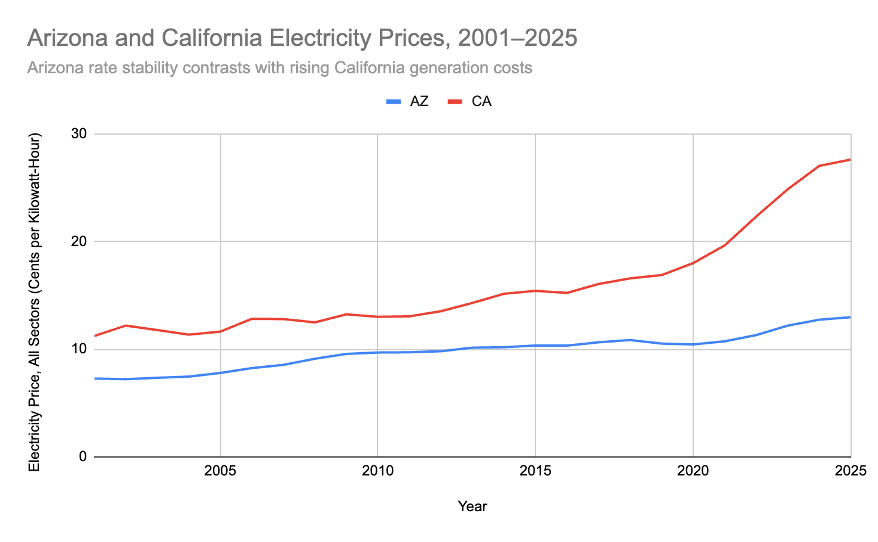
The consequences of rapid transitions in a regional grid are clearly illustrated by California's recent energy trajectory. Over the past two decades, California systematically retired a significant portion of its reliable baseload capacity, including two of its three nuclear generation facilities. This premature retirement of reliable baseload generation—combined with an aggressive, rapid shift toward intermittent solar and wind resources—has forced the state to rely on expensive, fossil-fueled peaker plants, while simultaneously becoming the nation’s second largest electricity importer. Consequently, California’s retail electricity rates have soared to historic highs, while Arizona’s all-sector rates have lowered accounting for inflation.
Resource Constraints and Water Management
Beyond market dynamics and financial volatility, expanding Arizona's energy infrastructure requires navigating the realities of an arid desert environment. Traditional thermoelectric power generation—whether driven by fossil fuels or certain solar thermal designs—demands massive volumes of water for cooling infrastructure, presenting a significant logistical hurdle for long-term grid expansion.
The state's current energy footprint features a highly sustainable model for resource management that protects the local water table. The Palo Verde Generating Station, for example—which supplies 36% of Arizona’s electricity—is uniquely engineered as the only utility-scale nuclear facility in the world cooled entirely by recycled municipal wastewater, utilizing treated effluent sourced from regional municipalities. By recycling this water, the facility maintains a 24/7 baseline supply of electricity without depleting Arizona's precious drinking or agricultural water reserves.
As the state plans for future growth, replication of this water-conscious framework is critical. The ongoing retirement of older, water-intensive coal facilities provides a strategic opportunity to modernize rural energy infrastructure. By prioritizing low-water, high-density generation assets to replace these retiring assets, Arizona can scale its power capacity to meet rising commercial demand without increasing the structural strain on its foundational water supplies.
Nuclear Energy and Small Modular Reactors
While nuclear energy provides a continuous, zero-emission baseload, traditional large-scale reactors require immense upfront financial commitments, often carrying a median project cost of roughly $12 billion per unit. However, advances in technology have given rise to the possibility of viable Small Modular Reactors (SMRs), which feature compact, factory-fabricated cores measuring roughly 9 feet across and 18 feet tall. Because these standardized components can be manufactured entirely in a centralized facility, they can be efficiently shipped via truck, rail, or water directly to an assembly site.
Despite this vastly reduced physical footprint, an individual SMR unit is capable of generating up to 300 megawatts of continuous electricity, carrying a median projected cost of approximately $4 billion—a two-thirds reduction in absolute upfront capital expenditure compared to large facilities.
This modular framework offers distinct integration advantages within Arizona's shifting infrastructure. Though still an evolving technology, deploying SMRs directly onto the footprints of retiring coal facilities could allow utilities to utilize existing high-voltage power lines and transmission infrastructure already connected to the regional grid, bypassing the need for expensive new corridor construction. From an operational perspective, this decentralized capability allows high-density power to be situated directly alongside expanding industrial corridors, semiconductor fabrication plants, and data centers. This localized generation provides an alternative for heavy industrial consumers requiring uninterrupted, zero-emission power without compounding the regulatory bottlenecks often associated with broader grid expansions.
Conclusion
Arizona’s energy landscape stands at a critical juncture, where historical stability must be successfully reconciled with a projected 40% surge in peak electricity demand over the next 15 years. Managing this transition involves navigating a complex web of internal and external variables. Nationally, growing vulnerabilities and rising retail rates demonstrate the risks of outpacing grid capacity with intermittent power sources. Regionally, Arizona's position within the Western Interconnection means its local economy remains permanently exposed to the supply deficits and policy decisions of neighboring states.
Ultimately, maintaining Arizona's competitive advantage in energy pricing and grid reliability requires balancing distinct operational, financial, and environmental trade-offs. Expanding the current resource portfolio requires energy planners to weigh the operational flexibility of natural gas against market volatility, the dependability of coal against environmental and water constraints, the effectiveness of nuclear against its massive up-front costs, and the zero-emission profile of solar against its inherent intermittency. How policymakers balance these trade-offs will ultimately dictate Arizona's long-term population and industrial growth.
- The AZ/CA prices graph was from EIA data found here and plotted here
- Pie chart from EIA data found here and plotted here
Understanding Child Sex Trafficking
Child sex trafficking is the commercial sexual exploitation of anyone under the age of 18 years old. Under both federal and Arizona law, a minor cannot consent to commercial sex – and in Arizona, a minor cannot consent to any sex act. If a child is exchanged for money, goods, drugs, shelter, or anything of value, that child is a victim of trafficking.
The issue of children being bought and sold for sex is prevalent in Arizona. Factors such as major interstate highways, proximity to other states and major metropolitan areas, tourism and sporting events, and an internationally known prostitution track or “blade” all contribute to the trafficker’s ability to transport and exploit victims. While the issue is certainly prevalent in Phoenix, child sex trafficking can – and does – occur everywhere in the state.
Most of the victims of sex trafficking in Arizona are in their teens. Exact statistics of the extent of this problem is tricky because of the difference between charged cases, convictions, and the problem as a whole. Sex traffickers are notoriously difficult to prosecute because of many victims end up lying to protect the trafficker.
Nationally and in Arizona, trafficking can appear in many forms. The most common are street level prostitution and online advertisements. When a victim is forced by their trafficker to walk the streets, this is often found on 27th avenue between Indian School and Northern Avenue. This is the nationally known prostitution track – commonly referred to as “The Blade” – in Phoenix. Here, victims are dressed in swimsuits, lingerie, or other revealing clothes and high heels and forced to walk up and down the street, trying to attract commercial sex buyers, or “Johns.” Traffickers will often give their victims a daily quota- how much money they are to make. Once that quota is met, they can come in for the day, just to be made to return the next night. The victims often work every day and depend on the trafficker for all basic needs, such as food, water, and shelter. The traffickers usually take all of the money the victims make, in exchange for their basic needs being met. The “dates” – or exchange of something of value for a sex act- often occur in the vehicle driven by the John, a hotel room rented by the trafficker, or victims may be taken to the home of the buyer. In all circumstances, the child victim is certainly at risk. Traffickers will park on the street, or remain nearby as to watch the victims and ensure they are working and not talking to other traffickers. They also often monitor the victims through tracking applications on their cell phones. They will tell the victim where to stand, when to move to another spot, or when they can take a break or go get something to eat or drink. The trafficker is in total control.
The other common way children are trafficked is through online prostitution websites. Traffickers will post ads with the victim’s photos in little to no clothing. The websites require that someone be 18 or older to post an ad, however traffickers get around this easily, by using fake IDs or someone else’s ID to post. Johns then go to the websites and essentially shop for a person to purchase. Phone numbers are listed on the ads, and the Johns can communicate with the victim or the trafficker through that number and arrange a date. These can be “in-call,” “out-call,” or “car dates.” In-call means the buyer will come to the victim, out-call means the victim will go to the buyer, and a car date would occur in a vehicle. Traffickers may run in-call dates from short term rental homes or hotels rooms and move around often to avoid detection. Victims will also likely have a quota as well when being trafficked online, and many are forced to post ads as well as walk The Blade.
Who is at Risk?
Any minor can be a victim of child sex trafficking. Traffickers will discover a vulnerability in the child and use that to their advantage. Importantly, victims can come from stable, loving, and secure families. They may also target children that are runaways, reside in group homes, have mental health or substance abuse issues, family conflict and single parent homes, a history of sexual or physical abuse, or children that are prevalent of social media without much supervision. Traffickers are often incredibly skilled manipulators that exploit a weakness or try to fill a void in the child’s life. They will use grooming tactics that are akin to those seen in sexual abuse cases. They earn the child’s trust and possibly even love, make them feel as though they are working in a team and that the trafficker will provide for the child if the child works for them.
Recruiting
Recruiting victims can occur in many ways. Often, victims are recruited by family members, and their trafficker is known to them. The trafficker then can easily exploit the venerability of the victim. Victims can often be recruited by friends in a school setting, group home, or behavioral health facility. Traffickers will often make their most trusted girl or boy that works for them their “bottom” and have that person recruit too. Far too often however, the recruiting is done online through social media and online gaming. Children who are left with little or no supervision online are especially vulnerable. Victims will either follow, “friend”, or like something on the trafficker’s profile/page. When a connection is made the trafficker goes to work manipulating the child into thinking that they care for them, love them, and will provide for them. It can happen incredibly fast or over time. Because children tend to post a lot of personal information online, traffickers will notice what a potential victim is posting about and use that to control and manipulate them. For example, if a child has suffered a recent loss, or posts about a divorce, or issues at home, a trafficker will use that as their way to make a connection with the child.
When a false romantic connection occurs – commonly called “Romeo pimps” or “finesse pimps” – it can be particularly confusing for the victim. They believe the trafficker is their romantic partner, that they are loved and in a committed relationship. The victim may not realize that they are in fact a victim. It will make leaving the situation or reporting the trafficker much more difficult. They tend to feel loyal and in love with the trafficker. This can also affect their cooperation with law enforcement and their willingness to aid in prosecution.
Victims are also controlled with threats, coercion, and violence. Once the trafficker has the victim, they must keep them working and making money. If a victim leaves “the life” of prostitution, that affects the trafficker’s bottom line. In order to keep them working and making their quotas, traffickers will threaten the victim themselves or their families, and even pets or children they may have with them. Traffickers also have either exploited an addiction, or supplied the victim with addictive drugs, creating the addiction. They will then only give them enough to make them still be able to work but also maintain the addiction. Violence is also often seen as a control tactic. Many Romeo pimps will change into a “Gorilla pimp” after initially recruiting the victim. If the victim wants out, they are often physically assaulted to maintain compliance and keep them making money. However the child is recruited, the amount of control the trafficker has over them continuously increases and because of this the victims can feel intense feelings of loyalty, dependency, isolation, fear, love, or a combination of these, which makes leaving and cooperating with law enforcement incredibly difficult.
Traffickers also control their victims through branding. Tattoos are often used by traffickers to mark or “brand” their victims. This is seen in tattoos of the trafficker’s name or street name, crown tattoos, and/or tattoos that are associated with money. These tattoos tend to be put in visible places so other traffickers will know this victim is the “property” of a particular trafficker and is a constant reminder to the victim.
Warning Signs of Child Sex Trafficking
While there are certainly some warning signs that a child is a victim of trafficking, they do not always exhibit any. A child may be going to school, doing their homework, socializing and acting completely normally and still be trafficked. However, a child may be experiencing trafficking if they:
• Suddenly possess expensive jewelry, clothing, or electronics – to include technology- without explanation
• Have a new boyfriend or girlfriend who appears to be controlling
• Running away from home or group homes
• Have unexplained injuries
• Become withdrawn, fearful, anxious, or depressed
• Have developed a dependance on their cell phones or technology
• Are secretive about their online activity
• Have multiple cellphones
• Display tattoos or branding associated to another person or group
No single sign proves trafficking, but multiple indicators should prompt concerns.
Common Trafficking Myths
Often, people associate trafficking with children being kidnapped and taken across country or state borders. While this may happen, it is far more common that the victims are manipulated by the trafficker whom they know through family, friends, or online and appear to be with them or leave with them willingly. They also may never leave their hometown and be trafficked where they live, either online or on the streets.
It is also a common misconception that only girls are trafficked. Gender and gender identity does not matter; any child can become a victim of trafficking. This also includes children of any sexual orientation as well.
Another myth is that a victim can easily leave. It may appear that the child is free to leave or report at any time. However, fear, trauma, threats, financial dependance, and emotional manipulation often prevent victims from escaping and reporting.
What is being done?
Law enforcement agencies throughout the state are stepping up their efforts to recognize and prevent trafficking. In many agencies across Arizona, law enforcement approaches victims of child sex trafficking with a trauma informed approach. This means that the victim is treated as a victim, not a criminal. They are supported through resources to try to get them out of “the life.” These resources tend to provide housing, stability and safety while also providing education and tools for victims to regain their independence or family connections. Laws in Arizona have also been reformed and enacted to focus on the root of the issue, which is the traffickers and the buyers.
Many agencies perform pro-active sting operations posing online as either victims of trafficking or commercial sex buyers. These efforts focus on finding possible traffickers who may be looking to recruit online, to find sex buyers looking to purchase minors for sex, or to rescue victims caught in “the life” and identify their traffickers.
In conclusion, child sex trafficking is a hidden crime that affects communities across the United States and in Arizona. Awareness, education, and early intervention are among the most effective tools for prevention. By recognizing the warning signs, supporting vulnerable youth, and reporting suspected trafficking safely, community members can play a critical role in protecting children and helping victims begin the path to recovery.
Authored by: Maggie Toth Esq. - Human Trafficking Prosecutor Maricopa County Attorney's Office
The Democratic Socialists of America (DSA) presents a problem for the Democratic Party and for the nation as socialism continues to make inroads among voters, especially the young. DSA membership soared, building on Senator Bernie Sanders’ presidential runs and Alexandria Ocasio-Cortez’s and Rashida Tlaib’s upset wins in House races in 2018. Most recently, Zohran Mamdani’s out-of-nowhere victory in New York City, added further fuel to the growth and influence of DSA. In 2026, the DSA counted 120,000 members, a significant increase from the previous peak of roughly 80,000 in 2020.
The membership number does not capture the appeal of the label: one-third of Democrats in a recent poll identified as democratic socialists. The current DSA is not a collection of old-fashioned social democrats: they are radicals who seek to transform America’s institutions and economy.
What the DSA Stands For
In 2026, the DSA approved a radical new platform. The platform calls for abolishing the Senate and replacing the Supreme Court and President with a judiciary and executive chosen by an expanded House picked through ranked-choice voting and proportional representation. The platform demands the enlargement of the electorate to include all permanent residents, prisoners, and felons. This political transformation, if successful, opens the path for a radical socialist socio-economic agenda.
This social economic agenda includes “gender-affirming care” and abortion without restriction, free college and the cancellation of student debt, new public housing and universal rent control, abolishing the police and prison system, phasing out fossil fuels, open borders, and abolishing ICE and prosecuting ICE agents. “Aggressive wealth taxes” will pay for the freebies, although DSA also supports confiscating the “largest corporations and essential industries.”
Pro-Palestinian planks are the foundation of DSA foreign policy: ending aid to Israel, prosecuting Israeli and US officials responsible for “war crimes” in Gaza, and a free Palestine with its capital in Jerusalem. DSA would also shutter the Pentagon, close bases abroad, and end sanctions on nations that act “independently of the United States,” including Cuba, Venezuela, and Iran.
The DSA, in short, seeks to destroy the framework of the American government and economy that just celebrated its 250th anniversary.
A History of Expansion
The DSA dates to the 1982 merger of two left-wing organizations. Membership hovered around 5,000-6,000. The party oriented itself around Scandinavian social democracy. Support for Israel was allowed.
In 2023, however, radical Marxist-Leninist communists took over the organization, driving out many social democratic members.
At the 2023 DSA convention, the various hardline factions attacked the moderates within the party for what they saw as tepid support for Gaza and the Palestinian cause. Those factions came to the 2025 convention energized and disciplined.
The Marxist and aligned groups in the "sectarian" wing now control over half of the seats on the governing board, with about one-third in the “mass party” group that seeks reform through popular figures like Sanders, with the rest independent. The Marxists got the platform they wanted, and aim to hold the candidates DSA supports to it. Local branches do not always reflect the direction of the national organization, but the national meeting defines the platform.
Where the DSA Thrives
Geographically, DSA chapters and candidates find their strength in college towns and dense ethnic urban neighborhoods. Particular strength is found in college graduates with lower annual earnings.
Despite the incantations about the working class, blue-collar workers are scarce among DSA members and supporters. “College-educated, mostly younger, mostly white progressives who are disillusioned by their economic opportunities and/or with the direction of the Democratic Party” occupy the DSA lane, according to political statistician Nate Silver.
Arizona cities and college towns do not fit the profile of DSA-friendly districts. Despite the seemingly endless large apartment complexes in Metro Phoenix, the districts are too suburban or too poor.
The “Soros Strategy”
For the most part, Arizona does not present natural territory for the DSA, but the party is making gains nonetheless. Arizona DSA success follows the "Soros Strategy" – a focus on low-turnout local races instead of splashy national ones. “[T]he next city council elections,” a DSA post promised, would not only improve people’s lives but also “build an enduring socialist majority in the years and decades to come.”
Successes, even small ones, produce more candidates who see themselves as "part of an ongoing project" and attract new members.
In municipal elections, DSA-connected candidates won a runoff election for an at-large city council in Tempe (public interest attorney and former DSA Phoenix chapter chair Bobby Nichols). In 2025, Miranda Schubert, a Tucson DSA stalwart, won a city council seat, backed by DSA volunteers who worked for her campaign.
DSA-endorsed Sadie Shaw narrowly lost her bid for a Tucson city council seat, so she returned to the school board, a position she has held since 2021.
In the 2026 primary, Miranda Lopez narrowly defeated Arizona House incumbent Stephanie Stahl Hamilton in Legislative District 21, a heavy Democratic held district that includes parts of Tucson, Nogales, and Bisbee. "People want Democrats to not only be socially liberal but also be more fiscally liberal and to recognize capitalism for the oppressive system that it is," Lopez said.
Lopez was among a group of five progressives who formed "No Safe Seats," which aimed to take out incumbents in Democratic districts by pooling their fundraising efforts. They ousted two.
The one big swing – an attempt to unseat Greg Stanton in the 4th Congressional District – lost decisively. Stanton’s vote for the Laken Riley Act and support for Israel were not obstacles to his keeping the Democratic nomination in the largely suburban East Valley district.
What Arizona DSA Chapters Provide
DSA has two full chapters in Phoenix and Tucson, and organizing committees in Flagstaff and Pima County. They are active in backing their candidates and causes, and in building community.
DSA chapters send out volunteer armies, canvassing and working phone banks. For example, Bobby Nichols, who won his race for the Tempe City Council, benefited from DSAers canvassing week after week before the election. In our money-saturated political world in which even some state legislative candidates employ paid canvassers, DSA’s volunteer foot soldiers are a valuable resource.
Activism
Outside of election season, DSA members promote their causes. Some of these track DSA preoccupations that have little public appeal. The Phoenix chapter, together with other left-wing groups, participated in protests against firms operating deportation flights out of the Mesa airport. The Arizona State University affiliate of the national YDSA campaigned to make ASU a sanctuary campus and to restore “trans-specific and LGBTQ+ wellness resources” websites as a first step toward full inclusion.
More consequential are those that hit 80/20 issues. While the cost of electric power is relatively low in Arizona, rising rates are a problem for many households.
The Tucson DSA chapter launched a campaign to replace Tucson Electric Power, which is owned by a Canadian firm, with municipally-owned power. Bolstered by its DSA council member, the city continues to explore its options for full or partial public ownership.
While full public ownership does not appear likely, the consistent canvassing forced Tucson Electric Power to accept a deal to expand low-income assistance and to support climate projects.
DSA and the Democratic Party
Maybe DSA will go the way of many radical organizations in the past by devolving into internal factional warfare. Meanwhile, DSA remains a force to be reckoned with in American politics.
With both established political parties, Democratic and Republican, deeply underwater in public opinion, space for alternatives is open. With both the party and much of its donor class increasingly unpopular, Democratic officials appear willing to go where the energy is, where the motivated base is. That means adopting full or modified DSA positions on Israel, immigration enforcement, tax-the-rich plans, and social welfare and healthcare spending. Political transformation- removing the Electoral College, expanding the Supreme Court, and extending statehood to Democratic strongholds like the District of Columbia and Puerto Rico – would guarantee power for the foreseeable future.
The DSA highlights 80/20 issues – “affordability,” data centers, and utility and housing costs, for example - issues that attract voters easily swayed by facile rhetoric. Both Democrats and Republicans ignore DSA at their peril.